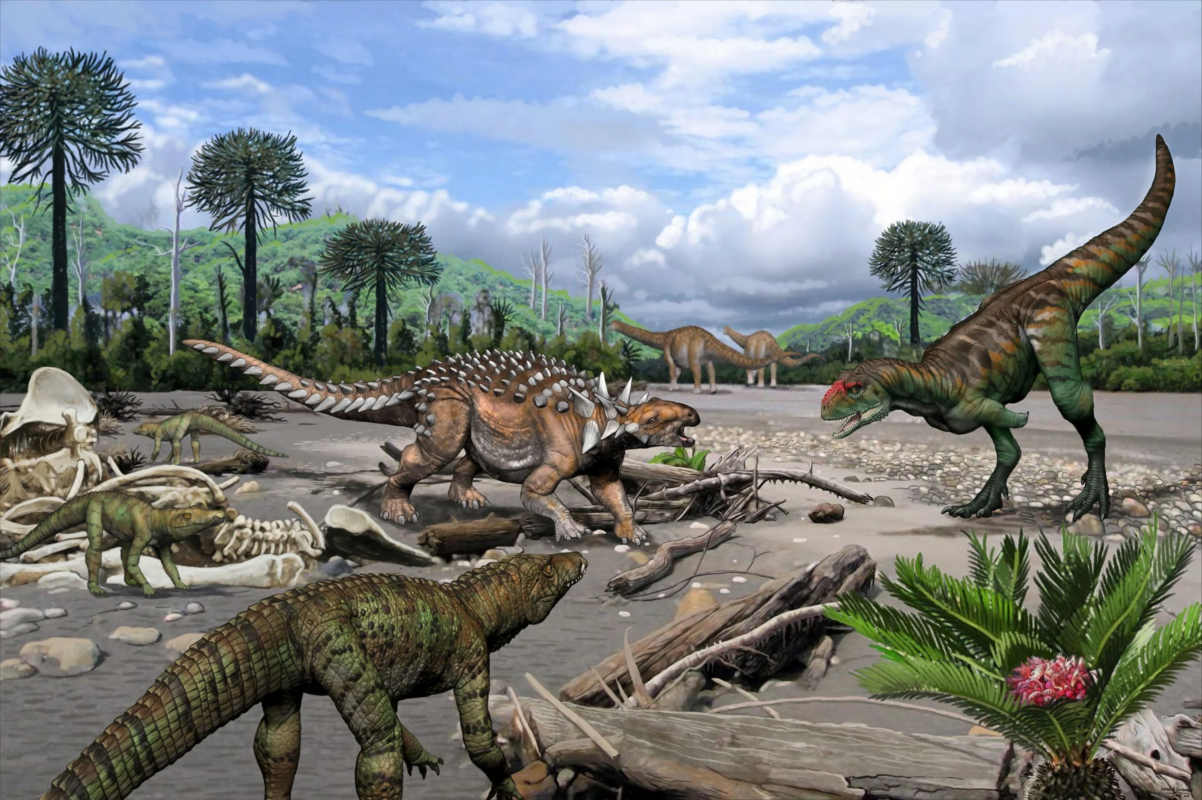
Plate Tectonics: The breakup of the supercontinent Pangaea continued, leading to more isolated landmasses. The Atlantic Ocean expanded, and the Indian Ocean began to open.
Shallow Seas: High global sea levels created vast inland seas, such as the Western Interior Seaway in North America, rich in marine life and significant for the sedimentary record.
2. Climate
The climate was generally warm and humid with minimal polar ice caps. High atmospheric carbon dioxide levels led to a greenhouse climate. Stable temperatures supported lush vegetation even in high-latitude regions.
3. Flora
The Late Cretaceous saw the rapid expansion and diversification of angiosperms (flowering plants), which began to dominate ecosystems. Gymnosperms like conifers, cycads, and ginkgos persisted but were outcompeted in many areas. Dense forests covered much of the land, creating habitats for evolving terrestrial animals.
4. Fauna
Terrestrial Fauna:
Dinosaurs: Renowned for its incredible diversity, including:
Theropods: Carnivores like Tyrannosaurus rex, Velociraptor, and Giganotosaurus.
Ornithopods: Herbivores like Edmontosaurus and other duck-billed hadrosaurs.
Ceratopsians: Horned dinosaurs like Triceratops and Protoceratops.
Ankylosaurs and Pachycephalosaurs: Armored and dome-headed dinosaurs.
Regional differences in dinosaur populations were evident due to continental separation.
Early Birds: Birds diversified with species like Ichthyornis and Hesperornis.
Mammals: Small mammals continued to evolve, setting the stage for post-Cretaceous diversification.
Marine Fauna:
Marine ecosystems thrived with creatures like:
Mosasaurids: Giant marine reptiles that became apex predators.
Plesiosaurs: Long-necked marine reptiles.
Ammonites and Rudists: Important marine invertebrates until the end of the period.
Sharks and Ray-Finned Fish: Significant diversification.
Insects:
Pollinating insects, including early bees and butterflies, co-evolved with flowering plants.
5. Mass Extinction Event
The Upper Cretaceous ended 66 million years ago with the Cretaceous-Paleogene (K-Pg) extinction event.
Causes:
Asteroid Impact: Evidence includes the Chicxulub Crater in the Yucatán Peninsula and a global iridium layer.
Volcanism: Massive eruptions from the Deccan Traps in India contributed to environmental stress.
Impact:
~75% of species, including all non-avian dinosaurs, marine reptiles like mosasaurs, and ammonites, went extinct. Survivors included small mammals, birds, and some reptiles, setting the stage for the Cenozoic Era.
Used to monitor number of Google Analytics server requests when using Google Tag Manager
1 minute
_gid
ID used to identify users for 24 hours after last activity
24 hours
_gac_
Contains information related to marketing campaigns of the user. These are shared with Google AdWords / Google Ads when the Google Ads and Google Analytics accounts are linked together.
90 days
_gali
Used by Google Analytics to determine which links on a page are being clicked
30 seconds
_ga
ID used to identify users
2 years
__utmx
Used to determine whether a user is included in an A / B or Multivariate test.
18 months
__utmv
Contains custom information set by the web developer via the _setCustomVar method in Google Analytics. This cookie is updated every time new data is sent to the Google Analytics server.
2 years after last activity
__utmz
Contains information about the traffic source or campaign that directed user to the website. The cookie is set when the GA.js javascript is loaded and updated when data is sent to the Google Anaytics server
6 months after last activity
__utmc
Used only with old Urchin versions of Google Analytics and not with GA.js. Was used to distinguish between new sessions and visits at the end of a session.
End of session (browser)
__utmb
Used to distinguish new sessions and visits. This cookie is set when the GA.js javascript library is loaded and there is no existing __utmb cookie. The cookie is updated every time data is sent to the Google Analytics server.
30 minutes after last activity
__utmt
Used to monitor number of Google Analytics server requests
10 minutes
__utma
ID used to identify users and sessions
2 years after last activity
SourceBuster is used by WooCommerce for order attribution based on user source.
Name
Description
Duration
sbjs_migrations
Technical data to help with migrations between different versions of the tracking feature
session
sbjs_current_add
Timestamp, referring URL, and entry page for your visitor’s current visit to your store
session
sbjs_first_add
Timestamp, referring URL, and entry page for your visitor’s first visit to your store (only applicable if the visitor returns before the session expires)
session
sbjs_current
Traffic origin information for the visitor’s current visit to your store
session
sbjs_first
Traffic origin information for the visitor’s first visit to your store (only applicable if the visitor returns before the session expires)
session
sbjs_udata
Information about the visitor’s user agent, such as IP, the browser, and the device type
session
sbjs_session
The number of page views in this session and the current page path
30 minutes
Marketing cookies are used to follow visitors to websites. The intention is to show ads that are relevant and engaging to the individual user.
Facebook Pixel is a web analytics service that tracks and reports website traffic.